August 24, 2026
What is computational electromagnetics (CEM)?
Note: This is my attempt at an introductory short essay on what Computational Electromagnetics is for an interested but uninitiated student/researcher. I deliberately do not delve into details but give the occasional keywords for the interested people to search for. If you want to dive into the deep end, contact me I’ll be happy to direct you to deeper resources.
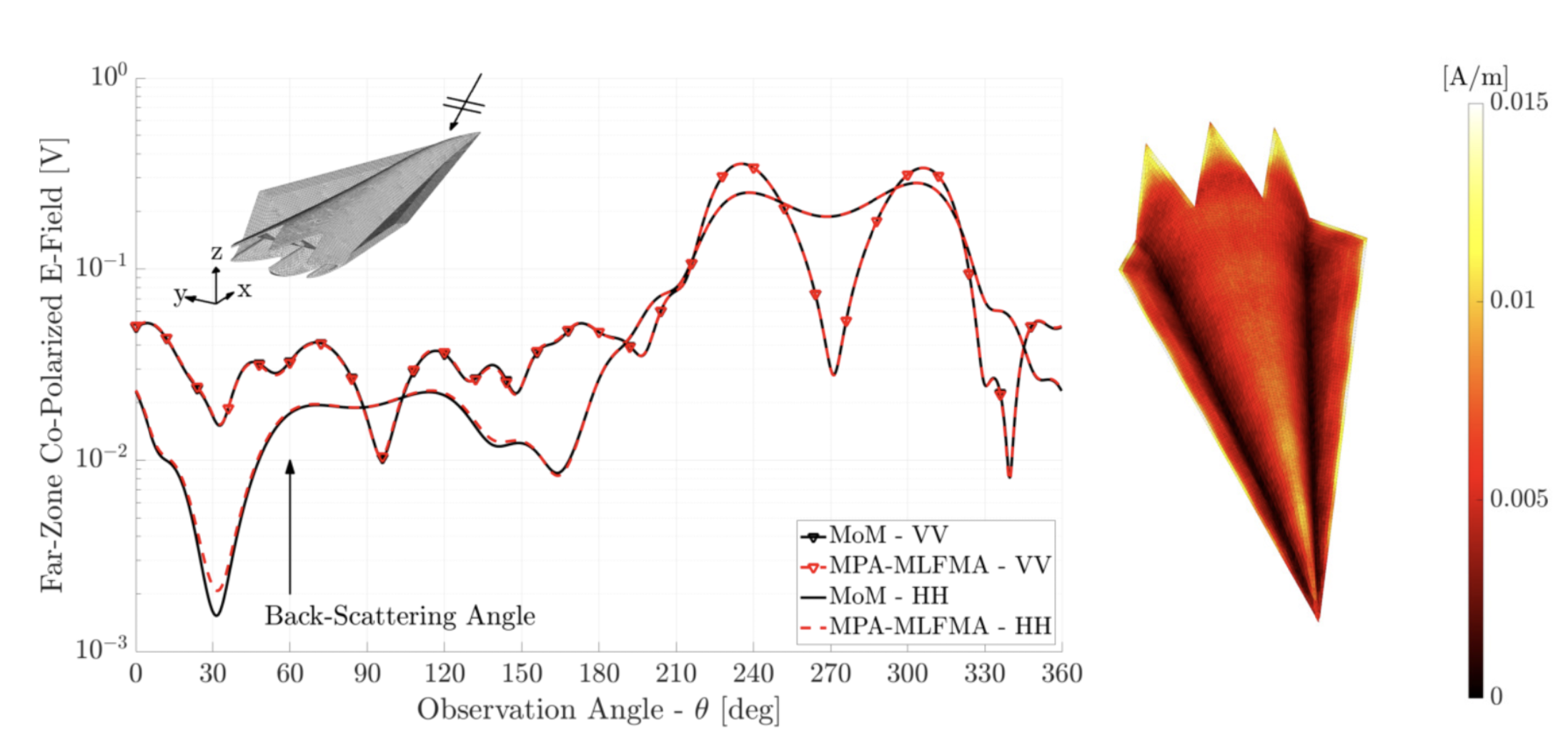
Electromagnetism (EM) is one of the four fundamental forces in the universe. From wireless communications to electronics to literally holding your molecules together, it is embedded in the fabric of the universe. We have the full theoretical understanding of how electromagnetic fields behave since Maxwell built the full picture in 1860s.
Using Maxwell’s equations, you can find out “analytically” how fields interact with simple and canonical shapes: a sphere, an infinite plane, an infinitely long wire etc. What you cannot solve analytically are almost everything else:
- a car (a simple radio antenna or a V2V network communications),
- the human body (how much EM radiation is absorbed by it from sources, e.g. cell phones, cell towers, MRI machines)
- a stealth aircraft (if you want to analyze its radar cross section)
The limitation is not the Maxwell’s equations themselves, but the tractability of implementing them for non-canonical shapes.
Addressing this limitation is a whole scientific field: computational electromagnetics (CEM).
Typical approach of a CEM method is almost rude in its simplicity. Chop the object into thousands of little pieces (“how” is a whole field in and of itself). Let every piece talk to every other piece (Method of Moments - MoM), and sometimes only let them speak with their immediate neighbors (Finite Element Method - FEM). Solve/Search for a meaningful scenario where all those conversations agree at once. Nature does this instantly and for free. A computer needs a discrete system to solve, say a linear system for N unknowns, for a full interaction this means N² conversations, and N gets big, fast.
Sixty years of CEM research is, more or less, about increasing the efficiency and speed while preserving the accuracy. Continuing with the “conversation” analogy, one huge branch of CEM research is about which conversations (interactions) you are allowed to skip/compress/group together. A massive speed-up over the conventional MoM is the Multilevel Fast Multipole Algorithm (MLFMA), where these conversations are held in a “group-by-group” manner.
The advancements in the efficiency of CEM methods, coupled with the raw exponential computational power available now is why there is an antenna array hiding behind your bumper, how the basestation finds your phone, and why a radar can pick a small drone out of a cluttered sky.
One thing I’m fascinated about CEM: the wave equation you get out of Maxwell’s equations is a 2nd order partial differential equation. You know what else are 2nd order partial differential equations? The Schrödinger equation in quantum mechanics. The heat equation. The Navier-Cauchy equations of linear elasticity that tell a bridge how much it may sag. The viscous terms in Navier-Stokes. Acoustic waves, which obey the wave equation wearing a different hat. Meaning CEM and the computational methods from a plethora of different disciplines actually feed each other. FEM was developed for mechanical analysis long before it became a staple in electromagnetics.
That borrowing goes both ways, and it is roughly where our group at Sabancı sits. The current work asks whether a neural network can learn which of those group-by-group conversations carry real information and which are near-copies of ones already computed — embedded inside the solver rather than replacing it, so every skipped interaction still comes with an error you can point at.
If you are interested in any of this: as a prospective student, a collaborator, or someone who just wants the deeper reading list, get in touch.