Research program

Intelligent electromagnetic environments

The post-5G era demands active control over the electromagnetic environment — not just antennas that radiate, but engineered surfaces and arrays that shape propagation for coverage, sensing, localization, and communication. My research targets three open limitations through one integrated program, building on 15+ years across computational electromagnetics, signal processing, and system prototyping.

01

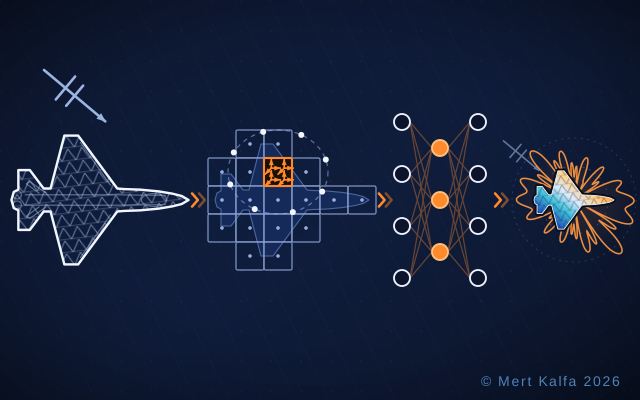
AI-augmented full-wave EM solvers for periodic & large-scale structures

Accurate full-wave simulation of large finite arrays, RIS, and metasurfaces remains a bottleneck in next-generation system design. I develop hybrid solvers that combine the rigor of classical methods — MoM, FEM, FDTD, MLFMA — with the scalability of deep-learning surrogates, to achieve fast, error-controlled analysis and to serve as differentiable cores inside design and control loops.

  • Physics-informed neural networks (incl. Kolmogorov–Arnold networks) for metasurface unit cells and finite-size effects
  • Graph neural networks encoding basis/test-function topology and inter-element interactions
  • Multi-precision / multi-fidelity pipelines that adaptively combine low- and high-resolution solvers
02

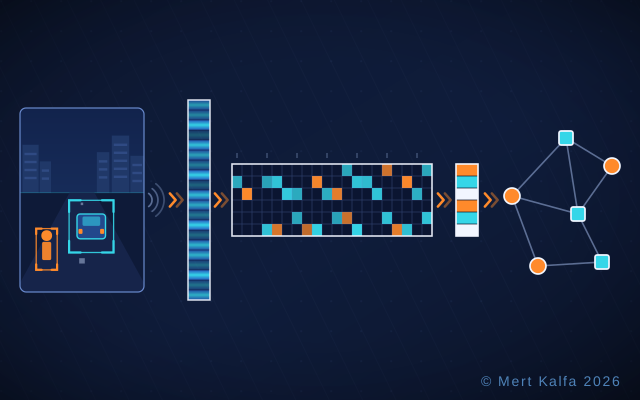
Compressive sensing & semantic extraction

Future wireless networks must be aware of their surroundings — to adapt to dynamic channels and to extract semantic information for imaging and localization. I build computational imaging pipelines using programmable metasurfaces and phased arrays that capture only the essential, task-relevant features of a scene.

  • Scene reconstruction by intelligent apertures from minimal RF measurements
  • Compressive channel acquisition with sparse arrays and sub-sampled architectures
  • RIS hardware testbeds to demonstrate the algorithms in practice
03

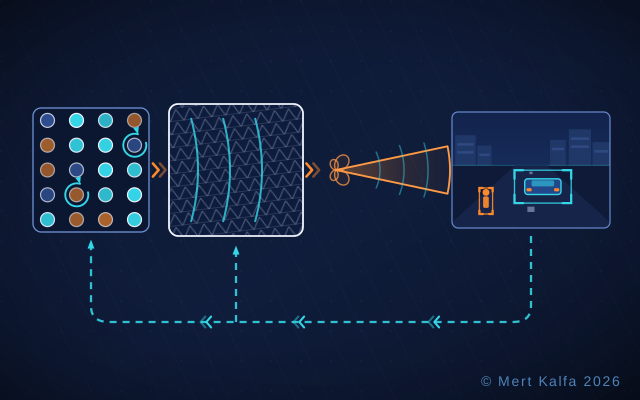
Goal-oriented optimization & design of intelligent EM environments

Traditional optimization targets generic metrics like SNR or throughput. Intelligent EM environments should instead be goal-oriented — optimized for downstream tasks such as localization, semantic extraction, or situational awareness. Differentiable EM solvers let gradients flow from those tasks back to physical parameters like RIS element states and beamforming weights.

  • Multi-objective, constrained optimization of metasurfaces and arrays
  • Hardware-aware task optimization (quantization, switching speed, mutual coupling)
  • End-to-end co-design where sensing, EM modeling, and inference are optimized jointly