AI-augmented EM solvers
Simulating electrically large objects, arrays, RIS, and metasurfaces accurately is still a bottleneck. We build hybrid solvers that pair the rigor of MoM, FEM, FDTD, and MLFMA with deep-learning / data-based surrogates — fast enough to live inside design and control loops.
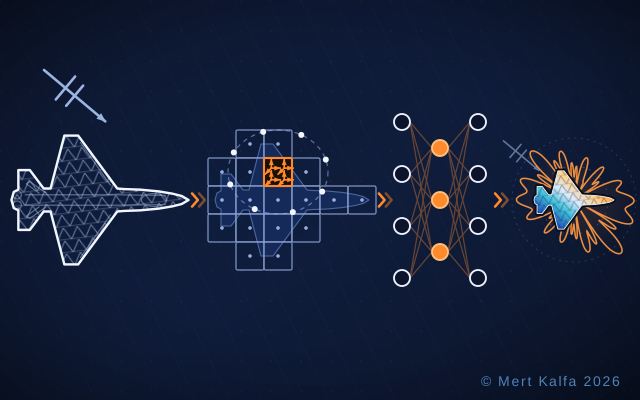
Accurate full-wave simulation of large finite arrays, reconfigurable intelligent surfaces (RIS), and metasurfaces remains one of the main bottlenecks in modern system design. Our work keeps the rigor of classical methods — MoM/MLFMA, FEM, and FDTD/FIT — but incorporates the scalability and inference capabilities of deep-learning surrogates, so simulations become fast enough to sit inside optimization and control loops.
This builds directly on my doctoral work, where multiple-precision arithmetic resolved a long-standing accuracy-versus-efficiency trade-off in broadband solvers. Current directions include physics-informed neural networks, graph neural networks that encode element coupling, and multi-fidelity pipelines that blend low- and high-resolution solvers.
- Physics-informed neural networks for full-wave solvers
- Multi-precision / multi-fidelity solver pipelines